The Word Mapping Formula
Learn the Mathematical Formula for Mapping Words Bidirectionally

Mapping the Alphabetic Code


Do we know how teachers support bidirectional word mapping at their students's point of need?
Can they Show the Code?

The Teacher Test of Phonological-Orthographic Mapping (POM) is the Phonics Screening Check for Teachers
Can your teachers orthographically map any word, in both directions, according to how it is pronounced? Do they know what their education department expects of them, and can they demonstrate that knowledge? Do they know why orthographic knowledge matters? Are they using The Word Mapping Formula? Increased confidence in their ability to map any word, at any time, also results in consistency across schools.

When adults attend Word Mapping Mastery® training, they learn how to use The Word Mapping Formula, The Word Mapping Tool and The 60-Second Spelling Routine.
These are used whether a learner is 3, 13 or 30, because the goal is to ensure that they become self-teaching and that reading and spelling become easier. It's never too late! However, it's far easier to prevent the need for intervention, so please do follow the Upstream Team at UpstreamSEND.com. We've just been awarded over £200,000 in funding to get the ball rolling towards screening all three-year-olds for dyslexia risk and providing support upstream. First Ripple SEN Support!

We show teachers how to use MyWordz® technology to check the mapping of words themselves. We teach them about the IPA so they understand how and why Phonemies® are used within the Innovate UK funded bidirectional word mapping technology as phonetic symbols for orthographic learners: anyone learning to read, spell and communicate in English. Also learn more about the first phonetic keyboard and one-screen AAC for non-speaking children here.
Show the Code: The Word Mapping Formula
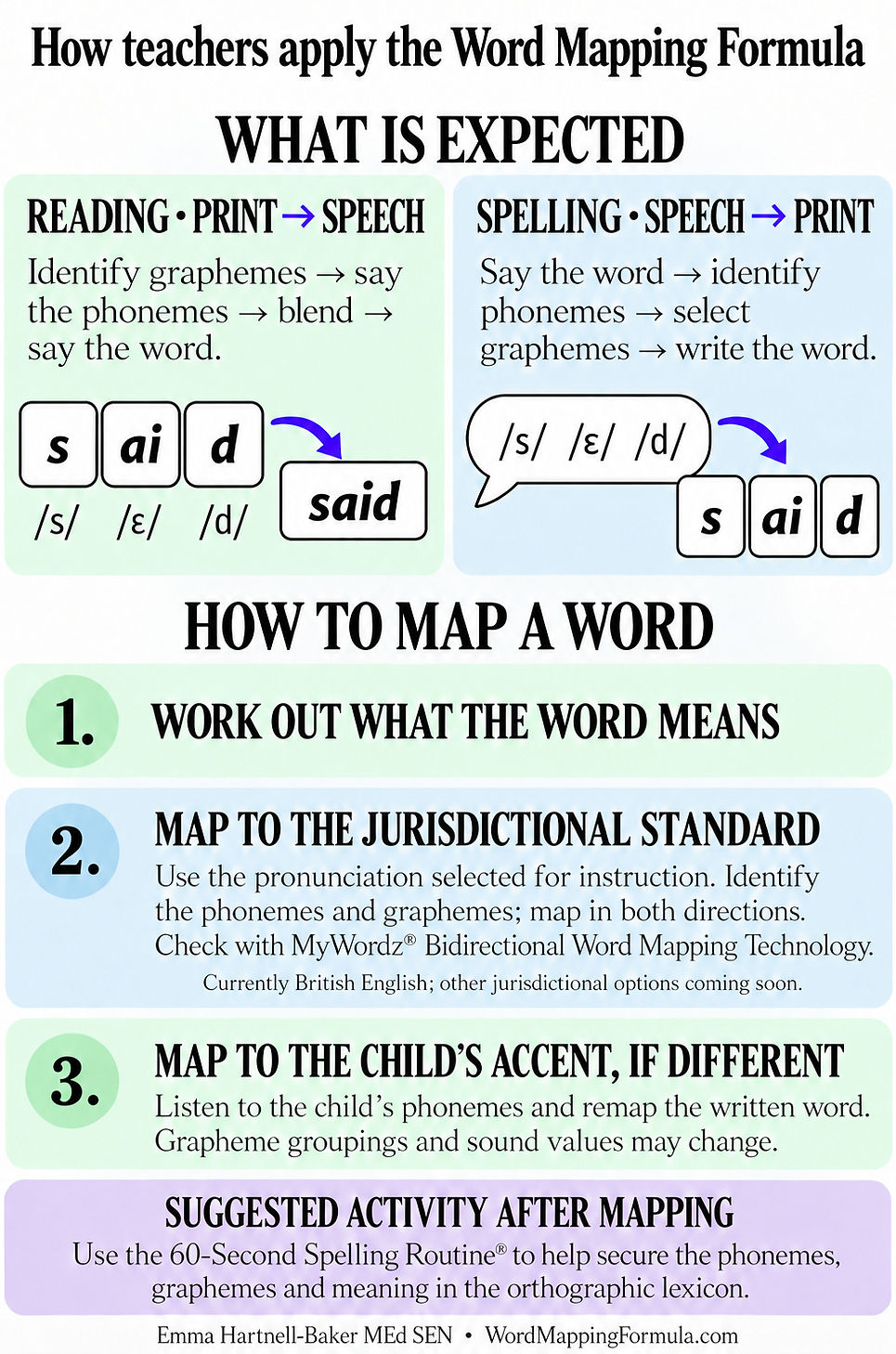
Mastery of phonological–orthographic mapping provides the underlying knowledge education departments already expect teachers to apply when supporting reading and spelling. Yet this knowledge is not currently routinely assessed during initial teacher education or in the workplace, so education departments and school leaders cannot assume that teachers can consistently do what guidance requires.
“Showing the code isn’t optional. But if they don’t know it, they can’t show it!”
Assessing and developing this mastery provides a way to establish that they can. It will also give school leaders and teachers the knowledge to evaluate phonics programmes more critically, understand what each programme does and doesn't provide, and make better-informed decisions about which programmes and approaches are most likely to meet the needs of their children. Teachers are better equipped to identify gaps, adapt or extend instruction where needed, support children to map unfamiliar words for reading and spelling throughout the school day, and analyse children’s own mapping to identify what they need next. This turns expectations about teacher knowledge into demonstrable practice and supports education departments in their wider goal of improving literacy standards.
“Schools should test all teachers working in primary education, as well as those delivering interventions. If they don’t know the code, they can’t show it.”
Emma Hartnell-Baker MEd SEN
The Upstream Team
%20(1).png)


Teacher Application of the Bidirectional Word Mapping Formula so that they can SHOW the Code to their students at the point of need.
Meaning + spoken word + written word → identify the phonemes and graphemes → show how they correspond in both directions
Apply it in this order:
1. Jurisdictional standard
Word meaning + reference pronunciation + spelling → standard word map
Print ↔ speech
2. Child’s accent, if different
Child’s pronunciation + the same spelling → child’s word map
Print ↔ speech
3. Teacher’s judgement
Compare the two maps → choose which pronunciation the child will map for this word → use the 60-Second Spelling Routine®
Result sought:
Speech sounds + graphemes + meaning → bonded in the orthographic lexicon → greater capacity for self-teaching new words
If the mapping is uncertain → check it with the word-mapping technology.